
One bottle says «CO₂-extracted», the next «full spectrum». Other manufacturers hardly write anything at all about how their CBD oil is actually produced. But how is CBD oil made? And how can you tell whether care was taken during production?
CBD oil is not simply pressed from hemp seeds. The starting point is the cannabinoid-rich parts of the hemp plant, primarily flowers and leaves. An extract is initially obtained from these. This is purified, processed, adjusted to the desired concentration using a carrier oil, and then bottled. The extraction process is not the only crucial factor. At least as important is what the laboratory report for the respective batch states at the end.
At a glance
- CBD is mainly extracted from the flowers and leaves of the hemp plant – not from the seeds.
- During CO₂ extraction, supercritical carbon dioxide dissolves cannabinoids and other plant compounds from the plant material.
- A common alternative is extraction with ethanol.
- Following extraction, depending on the process, further steps such as winterisation, filtration and decarboxylation follow.
- The concentrate is then adjusted to the desired CBD content using a carrier oil.
- A batch-specific laboratory report shows whether the CBD and THC content correspond to the stated values and which other parameters were tested.
The road to CBD oil:
Plant → Drying → Extraction → Purification and processing → Carrier oil → Bottling → Laboratory control
1. The raw material: Which plant parts are used?
CBD – cannabidiol – is found primarily in the inflorescences of the hemp plant. Tiny resin glands, known as trichomes, are located there. They contain cannabinoids as well as terpenes and other plant substances, whereas the seeds of the hemp plant play a different role. Hemp seed oil is pressed from hemp seeds. It can be used as a carrier oil for CBD, but naturally contains practically no CBD. This is an important distinction: CBD oil and hemp seed oil are not the same. Read more about this in our post what to look out for when buying CBD oil. The quality of the plant material also influences the final product. Origin, cultivation, time of harvest and drying help determine which plant compounds are available for extraction. Our plants grow in the Zürcher Oberland without herbicides. After harvest, the flowers are dried and prepared for extraction.
2. CO₂ extraction simply explained
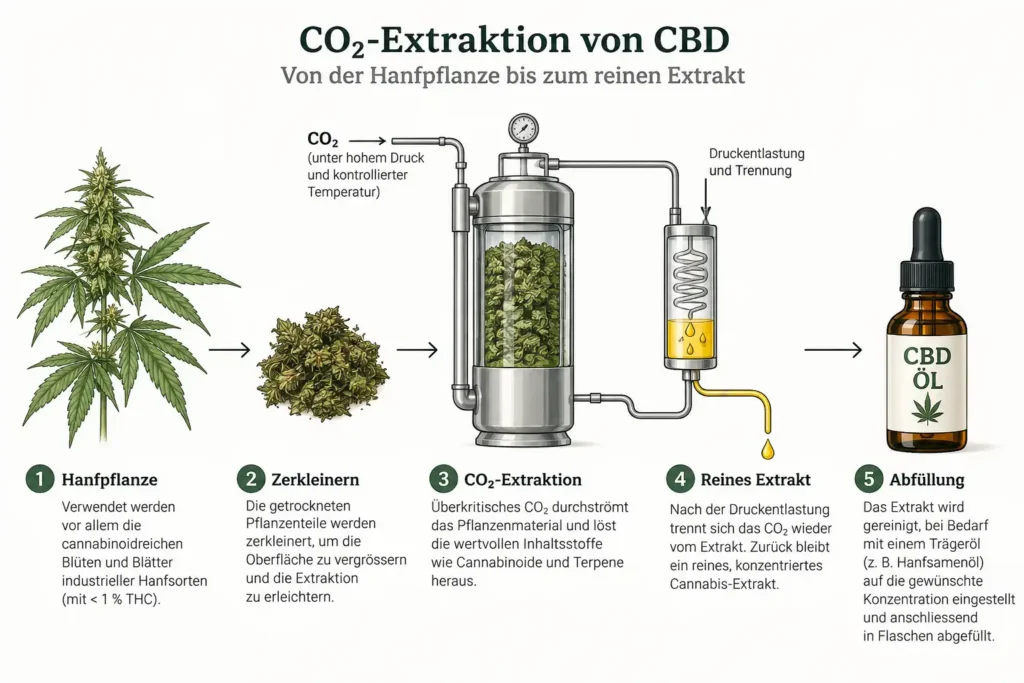
A commonly used method for producing CBD extracts is supercritical CO₂ extraction. That sounds more complicated than it is. We normally know carbon dioxide as a gas. However, if CO₂ is sufficiently pressurised and heated, it reaches a so-called supercritical state. Above around 31 °C and 74 bar, it possesses the properties of both a gas and a liquid. This allows it to penetrate deep into the plant material while simultaneously dissolving out specific plant compounds.
CO₂ extraction in four steps
- The dried and comminuted plant parts are placed in a pressure-resistant extraction vessel.
- CO₂ is pressurised and heated until it reaches the supercritical state. It then flows through the plant material, extracting cannabinoids and terpenes, among other things.
- The CO₂, laden with plant extracts, enters a separator. There, the pressure is reduced.
- The CO₂ turns back into a gas and separates from the extract. It can be discharged or recompressed and reused. What remains is the crude extract.
An advantage of this process is that pressure and temperature can be modified in a targeted manner. As a result, the extraction can be controlled. In addition, the CO₂ used does not remain in the extract as a conventional solvent residue.
The disadvantage: the printing systems required for this are technically demanding and correspondingly expensive. For our CBD oils, we use CO₂ extraction.
Ethanol extraction
Ethanol dissolves cannabinoids very well and is therefore frequently used for plant extractions. The process is comparatively easy to scale and requires less complex pressure equipment than a CO₂ system. In addition to cannabinoids, ethanol can also dissolve chlorophyll, waxes and fats from the plant material. Depending on the desired plant profile, this can be used intentionally; at the same time, subsequent processing steps may be necessary. The ethanol must then be removed from the extract again. Carried out cleanly, this method too can yield high-quality extracts. In solvent-based processes, it is therefore interesting to see whether the laboratory report contains corresponding residue analyses.
Other methods: olive oil, butane
CO₂ is not the only method for extracting cannabinoids from hemp. Other methods include, in particular, ethanol and extraction with vegetable oils or hydrocarbons.
Extraction with vegetable oil
Cannabinoids can also be dissolved directly in a plant oil such as olive oil. The process is technically simple. However, this results in a diluted oil extract instead of a concentrated extract. This makes further processing and precise standardization more difficult.
Extraction with butane and other hydrocarbons
Hydrocarbons can also efficiently extract cannabinoids from plant material. However, such substances are easily flammable and require suitable closed systems as well as careful removal and control of any solvent residues. Therefore, this method is less common for classic CBD oils.
Comparison of extraction methods
| Procedure | Solvents | Advantages | To be noted |
|---|---|---|---|
| CO₂ extraction | Overcritical CO₂ | Well controllable, moderate temperatures, CO₂ separates from the extract after pressure relief | Complex and expensive technology |
| Ethanol extraction | Ethanol | Distributed, efficient, well-scalable | Additional cleaning and removal of the ethanol required |
| Vegetable oil | For example, olive oil | Simple procedure | Diluted extract, difficult to standardize precisely |
| Hydrocarbons | For example, Bhutan | Efficient extraction at low temperatures possible | Inflammatory; residues must be controlled |
The extraction method alone therefore does not determine whether a CBD oil is good or bad. What is crucial is how well the entire process is controlled and what the analysis of the finished product shows.
What happens after the extraction?
After extraction, a dark, viscous crude extract is initially obtained. Before a finished CBD oil can be produced, further processing steps are necessary. Which of these steps are used depends on the manufacturing process and the desired end product.
Winterisation and filtration
During the winterization process, the extract is dissolved in ethanol and cooled to a very low temperature, for example to about –20 °C. This process can cause waxes and fats to precipitate. These solids are then filtered out and the ethanol is removed. The result is a further purified extract.
decarboxylation
In the fresh hemp plant, a large part of the later CBD is initially present as CBDA. By heating, CBDA is converted into CBD. This process is called decarboxylation. Temperature and duration must be controlled, as volatile plant compounds in particular can react sensitively to heat.
5. From extract to finished CBD oil
The purified extract is very concentrated and viscous. Therefore, for a ready-to-use CBD oil, it is mixed with a carrier oil. Typical carrier oils are:
- Hemp seed oil
- MCT oil
- Olive oil
In our CBD oils, we use cold-pressed hemp seed oil that is pressed at a temperature of no more than 37 °C. Additionally, we refine our aroma oil with a rosemary extract. This gives the oil a pleasantly fresh, natural fragrance and creates a soothing atmosphere that illuminates the room in a pleasant way.
The ratio between the extract and the carrier oil can be adjusted to achieve the desired CBD content. Our CBD oil PURE, for example, is available in 6 %, 16, % and 26 % CBD concentrations. We also source our high-quality hemp seed oil from a local organic farmer in the Zurich Upper Valley. We explain what these percentage values mean in more detail in the article. CBD oil test winner Switzerland.
6. Full-spectrum, broad-spectrum or isolate
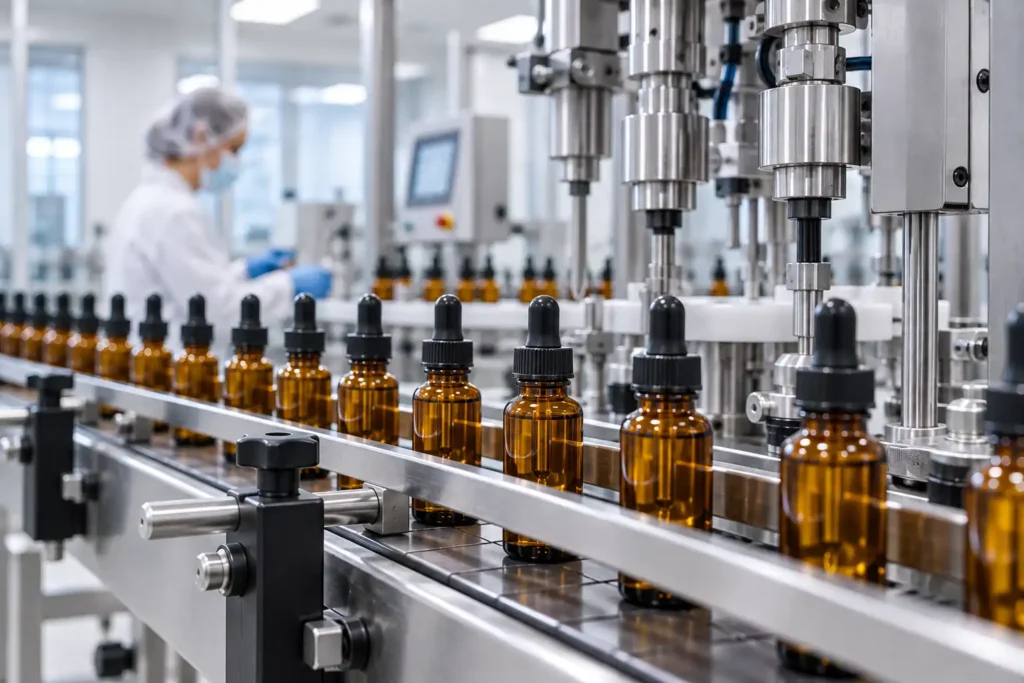
After extraction, the extracted extract can be processed and purified to varying degrees. With a full-spectrum product, in addition to CBD, other components of the hemp plant are retained. With a CBD isolate, however, CBD is very largely separated from other plant components. We explain in detail in our full-spectrum, broad-spectrum, or isolate comparison how these variants differ. After adjusting to the desired concentration, the CBD oil is bottled. A batch number allows the finished product of the corresponding production and analysis to be assigned.
How do you recognise high-quality CBD oil?
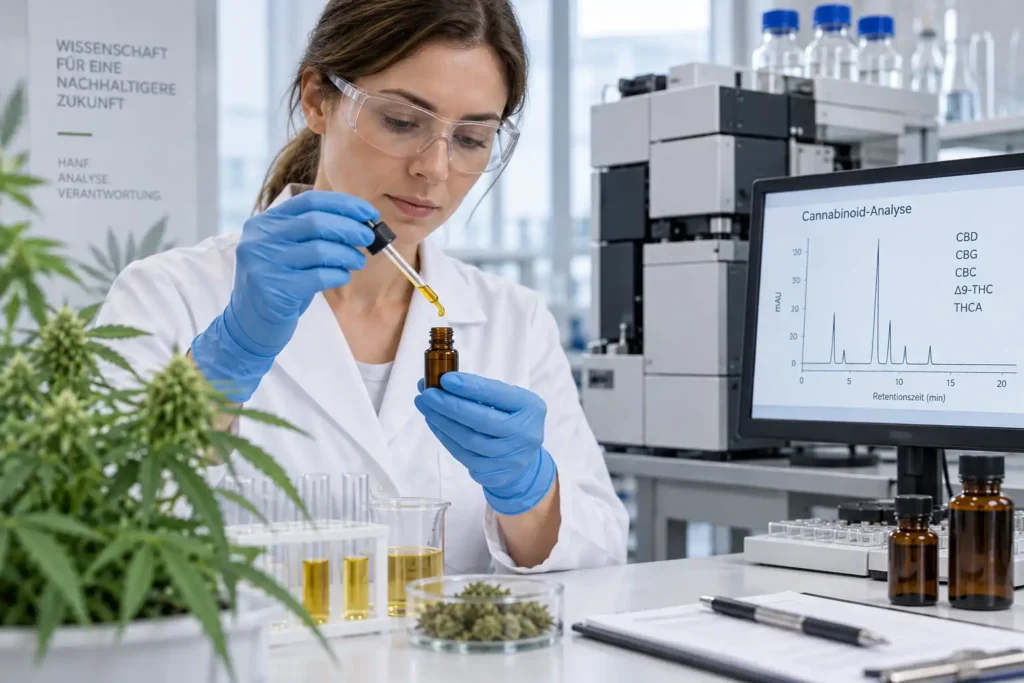
A lot can be written on a bottle. It becomes more meaningful if the information is documented in a comprehensible manner. An important reference point is therefore a Certificate of Analysis (COA) or a laboratory report for the specific batch.
How to check a laboratory report
Pay particular attention to:
Batch number: The report should clearly be included with the batch on your bottle.
Date: The analysis should match the corresponding production and not show any old measurement value.
CBD content: The measured value should match the declared concentration of the product.
THC content The report shows the THC content measured in the sample examined.
Examination scope: Don't just look at that, whether a laboratory report is available, but also on the, what It has been investigated. Depending on the product and the analysis, for example, cannabinoids and other purity parameters can be tested.
Laboratory: The report should indicate which laboratory carried out the analysis.
A laboratory report makes it transparent what was actually measured in the batch under investigation. It does not replace the assessment of the entire manufacturing process, but is significantly more informative than a quality promise on the label. Our current analyses can be delivered upon request.
What does the colour or scent of a CBD oil indicate?
Two CBD oils with the same percentage may look or smell different. This does not automatically mean a difference in quality. Extraction methods, purity levels, plant material, terpene profile, and carrier oil can all influence the final product. Therefore, full-spectrum products often have a more pronounced herbal aroma than highly purified products or isolates.
For our CBD Oil PURE we use the CO₂ extraction, while ours ENTRIE CBD Oil It is extracted with ethanol. This way we can target the extraction process to the desired plant profile and retain important plant characteristics. In the ethanol extraction, chlorophyll-containing plant components are also extracted, for example. A noticeably rancid odor, on the other hand, may indicate a problem with the oil or its storage. The percentage on the bottle thus only tells part of the story.
Frequently asked questions about the production of CBD oil
How is CBD oil manufactured?
CBD oil is produced from cannabinoid-rich parts of the hemp plant. First, the plant substances are extracted, for example with CO₂ or ethanol. The extract is then purified and processed according to the method, adjusted to the desired concentration with a carrier oil, and bottled.
Is CO₂ extraction better than ethanol extraction?
Both processes can yield suitable extracts. CO₂ can be controlled via pressure and temperature and is separated from the extract after extraction. This process requires complex pressure technology. Ethanol is also an established extraction agent. After extraction, however, it must be removed again and the extract often requires further purification steps. Therefore, the used process alone should not be judged. What is important are a controlled manufacturing process and the analysis of the finished product.
What is winterisation?
Winterization is a cleaning step. In this process, the extract is dissolved in ethanol and cooled very cold. This can remove waxes and fats, which can then be filtered out. After that, the ethanol is removed again.
What does COA mean for CBD oil?
COA stands for Certificate of Analysis. This is an analysis report for a sample or batch. It can include, among other things, the measured CBD and THC levels as well as, depending on the scope of the test, other analytical parameters. Be especially careful to note the batch number, date, the parameters tested, and the laboratory conducting the analysis.
Is CBD oil the same as hemp oil?
No. CBD oil contains an extract derived from cannabinoid-rich plant parts. Hemp seed oil, on the other hand, is pressed from the seeds of the hemp plant and does not contain any CBD by itself.
From plant to bottle: transparency counts
When producing a CBD oil, many steps are intertwined: plant material, extraction, purification, setting the concentration, bottling, and quality control. Therefore, I wouldn’t base the quality of an oil solely on terms like «CO₂-extracted» or «Full-spectrum.» What’s more interesting is whether a manufacturer explains in a comprehensible way:, how it is produced and what it actually tests.
At Qualicann, we use CO₂- and ethanol-extracted hemp extracts and cold-pressed hemp seed oil from an organic farmer for our CBD oils. The individual batches can be traced through the corresponding laboratory reports. Would you like to see what is produced at the end of this production process?
Sources
- Moreno, T., Montañés, F., Tallon, S. J., Fenton, T. & King, J. W. (2020): Extraction of cannabinoids from hemp (Cannabis sativa L.) using high pressure solvents: An overview of different processing options. The Journal of Supercritical Fluids, 161, 104850. For the journal article / DOI
- Fućak, T., Kreft, S., Svedružić, Ž. M. & Tavčar, E. (2023): Mechanism and kinetics of CBDA decarboxylation into CBD in hemp. Journal of Plant Biochemistry and Biotechnology, 32, 608–621. For the journal article / DOI
- Federal Office of Public Health (FOPH): Cannabis – THC-rich cannabis and cannabidiol (CBD). Information about the Swiss legal framework and about CBD products. To the BAG website
- Raber, J. C. et al. / Overview: Extraction of Cannabinoids from Cannabis sativa L. (Hemp)—Review. Agriculture, 11(5), 384 (2021). Overview of extraction processes as well as downstream processing steps such as winterization and filtration. For the professional article