
They stand in the grocery store in front of the oil shelf. Between rapeseed and olive oil, a green bottle with hemp leaves is on the label, 250 ml for a few francs. Is this a cheap CBD oil? No. Although CBD oil and hemp oil are derived from the same plant, they are two different products. The short answer: Hemp oil is pressed from hemp seeds and does not contain CBD. CBD oil contains an extract from flowers and leaves containing cannabidiol (CBD). This difference also explains the different ingredients, different applications, and prices.
At a glance
- Hemp oil (also hemp seed oil) is a cold-pressed edible oil made from hemp seeds. It contains no CBD, apart from possible traces due to contact with other plant parts.
- CBD oil contains an extract from flowers and leaves, dissolved in a carrier oil such as MCT oil or hemp seed oil.
- Hemp oil provides mainly Omega-3 and Omega-6 fatty acids; CBD oil contains cannabidiol and, depending on the product, other plant compounds.
- On the label, you can recognize the difference based on the CBD content, the carrier oil, the laboratory report, and the warning symbols or other markings present depending on the intended use, which indicate that the product is not intended as a food product.
Hemp oil: From the seeds, no CBD
What is hemp oil made from?
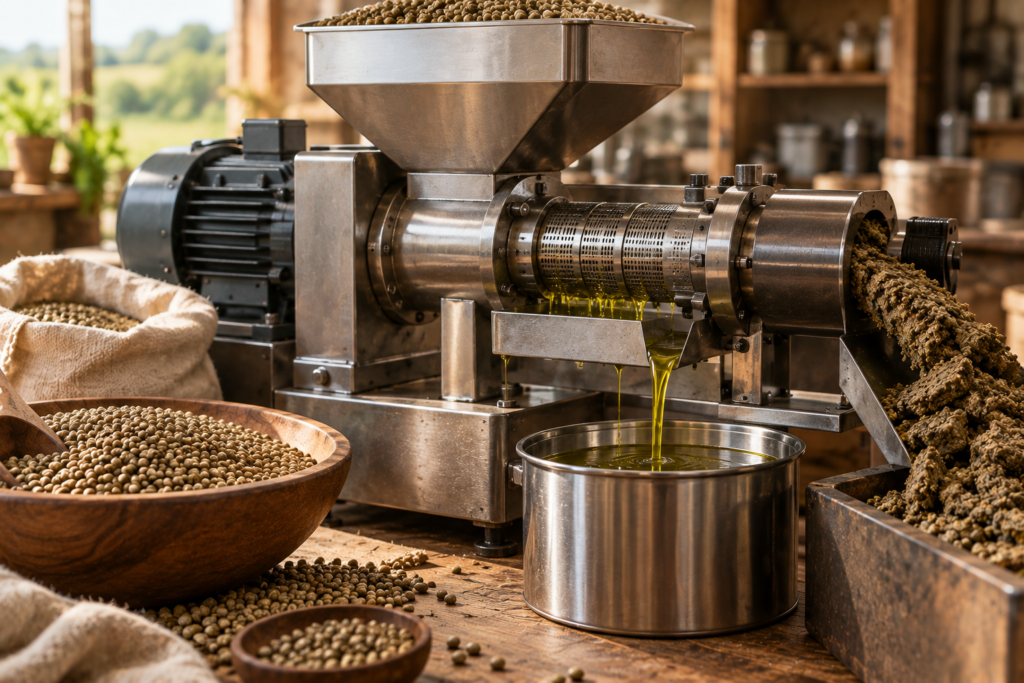
Hemp oil is pressed from the seeds of the hemp plant, usually by cold pressing. The result is a greenish edible oil that is particularly suitable for cold cooking, such as for salad dressings. CBD does not naturally contain it. Cannabinoids such as CBD and THC are produced in the glandular hairs (trichomes), which are located primarily on flowers and smaller leaves. Hemp seeds do not have these glandular hairs.
The German Federal Institute for Risk Assessment states that hemp seeds do not contain «any THC as an ingredient»; traces can be present in the harvest through contact with other plant parts to the seed coat [3]. The St. Gallen Cantonal Laboratory also states that unlike flowers and leaves, hemp seeds do not contain cannabinoids [2]. A comparison helps: Hemp oil behaves similarly to CBD oil, like linseed oil to linen fabric. Both come from the same plant, but are produced from different plant parts for different purposes.
Why is hemp oil considered a valuable cooking oil?
Primarily due to its fatty acids. According to a review by J. C. Callaway, hemp seed oil consists % of more than 80% of polyunsaturated fatty acids, including around 56 % linoleic acid (Omega-6) and around 22 % alpha-linolenic acid (Omega-3) [1]. The ratio of Omega-6 to Omega-3 is therefore approximately 2.5 to 1.
CBD oil: From flowers and leaves, with CBD
How is CBD oil produced?
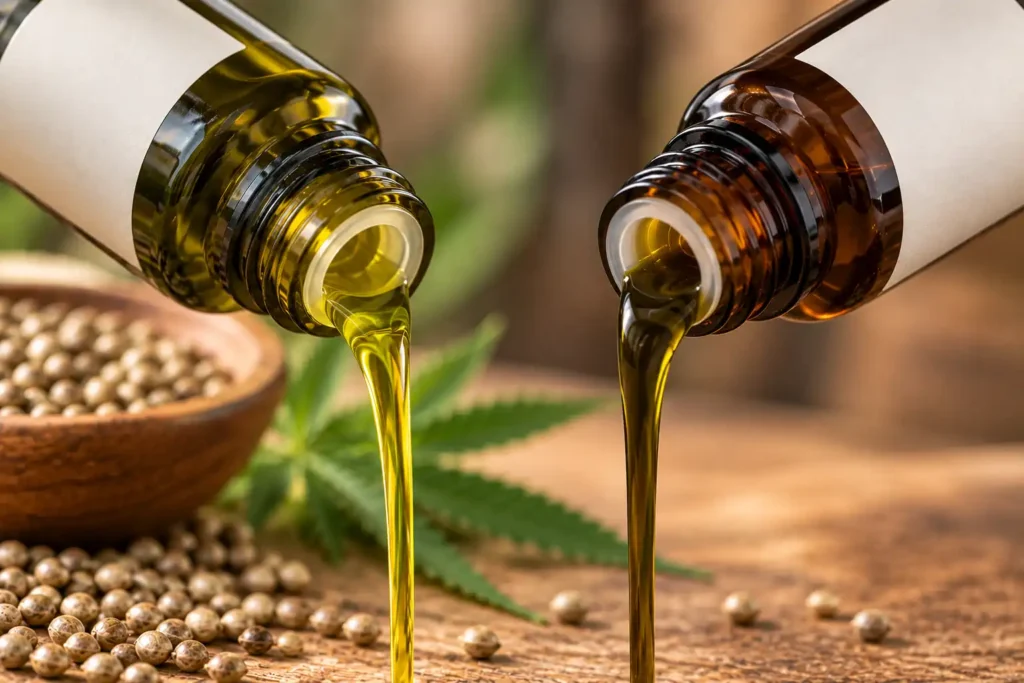
For CBD oil, an extract is extracted from the flowers and leaves of THC-low hemp and subsequently dissolved in a carrier oil. This extract contains cannabidiol (CBD), a non-intoxicating cannabinoid, and depending on the extraction method, additional plant compounds. How the production process works in detail is shown in the article on CBD oil production. The carrier oil forms the actual oil portion in the bottle. MCT oil is often used, which is mostly extracted from coconut. Olive oil or, as in our case, hemp seed oil are also possible. This can lead to confusion: A CBD oil can contain hemp seed oil as a carrier oil. However, hemp seed oil alone is not yet a CBD oil. Different forms of extract are distinguished. Full-spectrum oils contain additional cannabinoids and terpenes alongside CBD. Isolated oils, on the other hand, contain isolated CBD without these accompanying compounds.
How much THC can CBD oil contain in Switzerland?
In Switzerland, the limit of 1% % THC is particularly relevant. The Federal Office of Health states: «Hemp with a THC content of less than 1% is not subject to the Narcotics Act» [4]. Our oils fall below this limit; each batch is tested in accredited laboratories. There are also differences in product classification. Hemp oil is a food oil. Our CBD oils are flavor products.
How do you recognize the difference on the label?
The easiest way to check is to look at four points. This usually allows you to determine within a few seconds whether you have hemp seed oil or a CBD oil in front of you.
The label checklist in four steps
- Is a CBD content indicated?
A CBD oil usually lists the CBD content in percentages and sometimes in milligrams as well. A 10 ml bottle containing 10 % contains, for example, 1’000 mg of CBD. If a CBD statement is completely missing, it is very likely not a CBD oil. - Is a carrier oil named?
In CBD oil, in addition to the hemp extract, you will find a carrier oil such as MCT oil, olive oil, or hemp seed oil. In classic hemp oil, on the other hand, hemp seed oil is the focus, often with the addition of «cold-pressed.». - Is there a laboratory report?
Serious CBD manufacturers can provide analysis certificates for the batch. These certificates allow, among other things, to track the CBD and THC content. Our analyses can be requested at any time. Warning symbolism and intended use
In terms of warning symbols and intended use, the two oils also differ significantly from each other. While hemp seed oil is used as a cooking oil and is therefore classified as a food product, CBD oil is not a food product. This difference is also clearly evident in the respective labeling and the intended use stated.
A practical example: A 250 ml bottle labeled «Bio Hemp Oil, Cold Pressed,» with a nutritional table and expiration date is a food oil. A 10 ml bottle labeled «15 % CBD,» with a batch number and laboratory report is, however, a CBD oil. Caution is advised when using terms like «Hemp Extract» without specific quantity information. Without CBD content and analysis, it is not possible to reliably determine whether and how much CBD a product contains.
What is in it? Ingredients compared
What ingredients distinguish hemp oil and CBD oil?
Hemp oil primarily provides fatty acids. In the case of CBD oil, cannabidiol and – depending on the type of extract – other cannabinoids and terpenes are the primary components.
| Comparison | Hemp oil (hemp seed oil) | CBD oil |
|---|---|---|
| Origin | Pressed from hemp seeds | Extract from flowers and leaves, dissolved in carrier oil |
| CBD content | None; at most traces due to contact during harvesting | Declared CBD content |
| Fatty acids | Rich in Omega-6 and Omega-3 (approx. 56 % and 22 respectively %) | Depending on the carrier oil used |
| Terpenes | Hardly available | Available |
| Use | Cooking oil for the cold kitchen | Aroma oil |
| Price | Few francs per 100 ml | Significantly higher, as extraction and analysis are required |
There are also differences in the aroma. Cold-pressed hemp oil smells slightly nutty. Full-spectrum CBD oil usually has a distinct, strong, earthy-harsh scent, which is influenced by the terpenes in the flower, among other things. In isolate products, the scent is much milder and spreads discreetly throughout the room.
A common misconception: «Hemp oil is diluted CBD oil»
That is not true. Hemp oil is not a weak or diluted CBD oil, but a separate product derived from another part of the plant.
The price difference and why it is justified
Why is CBD oil so much more expensive than hemp oil?
Because the production is more complex. Hemp seed oil can be pressed directly from the seeds. For CBD oil, on the other hand, cannabinoid-rich plant parts must be grown, harvested, dried, and extracted. Subsequently, the extract is adjusted to the desired CBD concentration. At Qualicann, we grow our plants ourselves in the Zurich Oberland region, under LED light and without herbicides. After harvesting and drying, extraction and the production of the respective concentration follow. In addition, there are analyses: Each batch is tested for CBD and THC in an accredited laboratory. This allows checking whether the declared CBD content is correct and the THC content is within the applicable limits. Our laboratory reports are made publicly available. The higher price of a CBD oil is therefore not due to the carrier oil, but primarily to the cultivation, flower production, extraction, processing, and analysis.
Frequently Asked Questions
Is hemp oil the same as CBD oil?
No. Hemp oil is pressed from hemp seeds. CBD oil, on the other hand, contains a CBD-containing extract from flowers and leaves that is combined with a carrier oil. Furthermore, there are different areas of application.
Does hemp oil contain CBD?
Hemp seeds themselves do not produce cannabinoids. Traceable amounts can be produced through contact with flowers or leaves during harvesting and processing [2][3].
Is hemp seed oil the same as hemp oil?
Yes. Both terms refer to the edible oil made from pressed hemp seeds. However, hemp seed oil can also be used as a carrier oil for a CBD oil.
Why is CBD oil more expensive than hemp oil?
CBD oil requires additional production steps such as growing cannabinoid-rich flowers, extraction, adjusting the CBD concentration, and laboratory analyses. Hemp oil, on the other hand, is pressed directly from the seeds.
How do I recognize genuine CBD oil?
Pay attention to a clearly stated CBD content, the indication of the carrier oil and a traceable laboratory report for the batch. These three points allow for a quick product check.
Conclusion
CBD oil or hemp oil is not a matter of better or worse. Hemp oil is a cooking oil made from hemp seeds and is particularly characterized by its fatty acids. CBD oil, on the other hand, contains an extract from flowers and leaves with a defined CBD content. Anyone who pays attention to the CBD information, carrier oil, and laboratory report when purchasing can easily distinguish between these two products. If you are interested in CBD oil, you will find it in our category CBD Oil Full spectrum and Isolate oils Made in Switzerland. For each batch, we provide a laboratory report.
Sources
Callaway, J. C. (2004): Hempseed as a nutritional resource: An overview. Euphytica, 140, 65–72.
Study by Springer / DOICantonal Office for Consumer Protection and Veterinary Affairs of St. Gallen (2022): Food containing hemp – information and legal requirements.
Leaflet from the canton of St. Gallen (PDF)Federal Institute for Risk Assessment (BfR): Questions and answers about the health risks of foods and feed containing hemp. Federal Institute for Risk Assessment
BfR – Questions and answers about hemp-containing foodsFederal Office of Public Health (FOPH): Current legal status of hemp and cannabis products. The current BAG page also specifically confirms the classification of THC-low hemp as category 1, which is relevant to your article %. Federal Office of Health
BAG – Legislation for hemp and cannabis products