A question that keeps coming up in our customer service and on relevant forums is: How many grams CBD flowers or how many small bottles CBD oil can you actually have at home or with you? Anyone looking for this will primarily find vague answers or references to German law, which has little to do with the legal situation in Switzerland. The short answer first: There is no legally defined quantity for CBD possession in Switzerland. Why this is the case, what actually happens during a police check, and what you should watch out for when importing into Germany can be read below.
At a glance
- In Switzerland, there is no legal limit for CBD products containing less than 1 % THC – they are not covered by the Narcotics Act (BetmG).
- Legal CBD flowers and illegal THC cannabis cannot be distinguished with the naked eye or by smell; individual cantons are therefore now relying on a rapid chemical test.
- Original packaging, proof of purchase and Certificate of Analysis (COA) are not legally required, but they make an inspection noticeably easier.
- In Germany, CBD products are subject to a THC limit of 0.3 % – Swiss CBD flowers containing up to 1 % THC often exceed this limit, making their import particularly tricky.
- At the airport, it is not Swiss law that counts, but the law of the destination country – it is worth checking this before travelling.
Is there a maximum quantity?
No – at least not in the sense of a fixed quantity in grams or millilitres. It is not the quantity that is decisive, but the THC content of the product. If this is below 1 %, the product is not classified as a narcotic within the meaning of the Narcotics Act [2], in accordance with the Ordinance of the Federal Department of Home Affairs on the Lists of Narcotics. Without this classification, none of the quantity rules applicable to THC-containing cannabis apply. Anyone who possesses CBD flowers, CBD hash or CBD oil containing less than 1 % THC is therefore not subject to the Narcotics Act – regardless of whether the quantity is two grams or two kilograms. The Federal Office of Public Health also states that CBD products below this threshold are not subject to the Narcotics Act [1].
This is easily confused with the regulations for recreational cannabis, which exist on a selective basis in Switzerland: in cantonal pilot projects, registered participants are allowed to obtain regulated THC cannabis in limited monthly quantities, and since the 2024 Cannabis Act, Germany has had a personal use limit of 25 grams of THC cannabis. However, both figures relate to psychoactive cannabis above the THC threshold – not CBD products, such as those sold by Qualicann. This confusion is one of the most common misconceptions we encounter in customer conversations.
In practical terms, this means that even a larger order of CBD flowers for private use is unproblematic in terms of ownership rights. In such cases, a healthy dose of common sense rather than the law sets the limit – anyone carrying litres of CBD oil or kilos of flowers with them must expect a controller to ask questions, for example regarding commercial resale without the appropriate licence. However, that then concerns commercial law rather than narcotics law.
What applies during a police check?
In short: you are permitted to possess, carry and consume legal CBD containing less than 1 % THC. The real problem lies not in the law, but in practice – because CBD hemp and THC-containing cannabis cannot be distinguished with the naked eye. Some cantons have therefore introduced a rapid chemical test: A small sample is placed in a test kit containing two glass ampoules, which are then crushed. If the liquid turns red, this indicates legal CBD hemp; if it turns blue, it indicates cannabis containing THC. The test takes around two minutes and costs the police less than five francs per test [3].
Before the introduction of these rapid tests, suspicious samples had to be sent to a laboratory, which cost around 300 francs per analysis and took days – usually resulting in the provisional seizure of the goods for the person concerned. Today, according to the cantonal police, a laboratory test is only necessary if the rapid test is THC-positive and the person concerned contests the result [3]. This speeds up the vast majority of checks considerably, even though not all cantons yet have the relevant test kits and some continue to rely on traditional laboratory analyses.
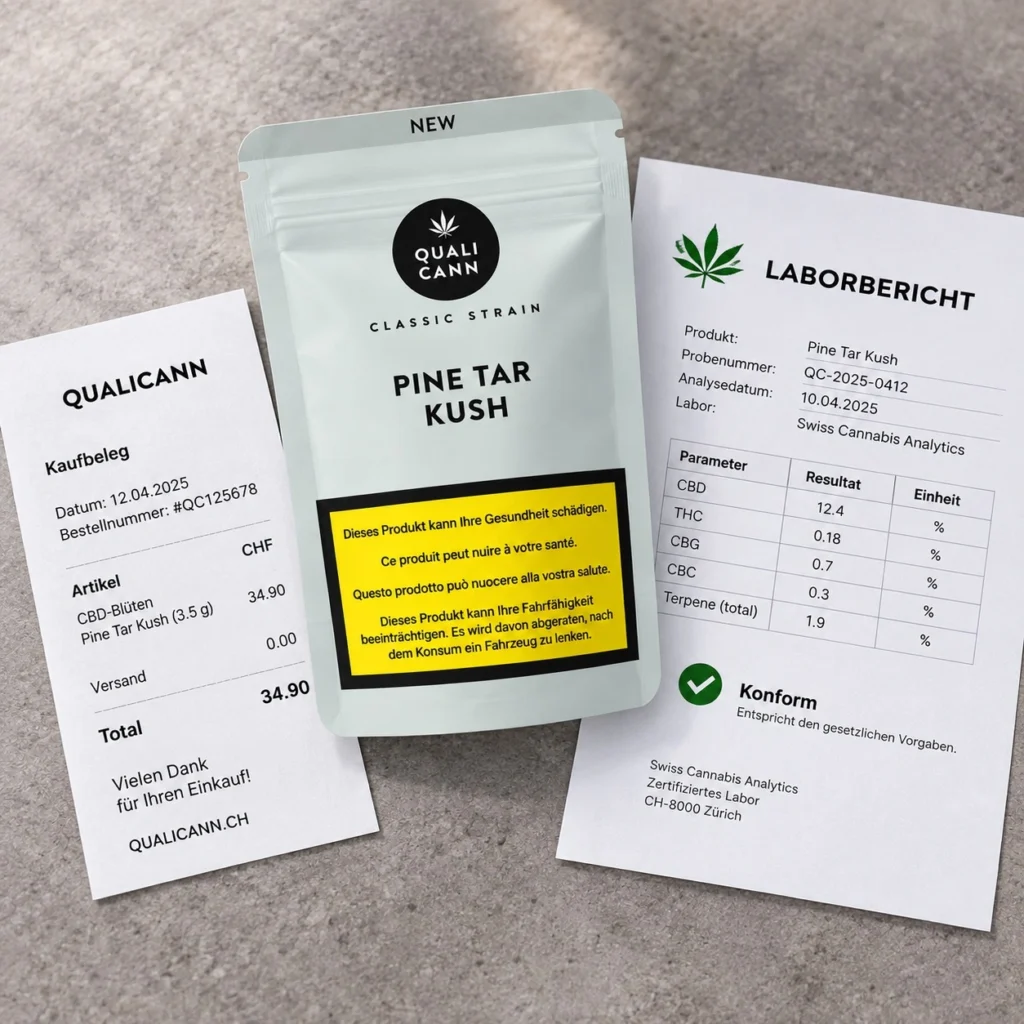
Even though the rapid test defuses the situation considerably, a few simple precautions are worthwhile: where possible, keep CBD flowers or hash in their original packaging with the strain name, keep the purchase receipt and – if available – carry the laboratory certificate (COA, Certificate of Analysis) for the respective batch, for example as a PDF on your smartphone. None of this is required by law, but it noticeably shortens an inspection and takes the wind out of the sails of any questions.
How does the police distinguish between CBD and THC cannabis?
Neither visually nor by smell: Both plants belong to the same species, Cannabis sativa, and differ chemically primarily in the ratio of THC to CBD – not in the shape, colour or aroma of the flower. This indistinguishability was long the biggest practical problem during inspections and a reason why some police forces treated CBD consumers with blanket suspicion.
The new rapid test solves precisely this problem by chemical means: the reagent liquid reacts differently to THC- and CBD-dominant samples and displays the result via a change in colour, without the need for a laboratory to be involved [3]. In most cases, the procedure thus replaces complex and expensive laboratory analysis and provides clarity within a few minutes – an advantage both for the police and for consumers, who would otherwise have had to surrender their CBD flowers as evidence for days.
Taking CBD to Germany: What applies?
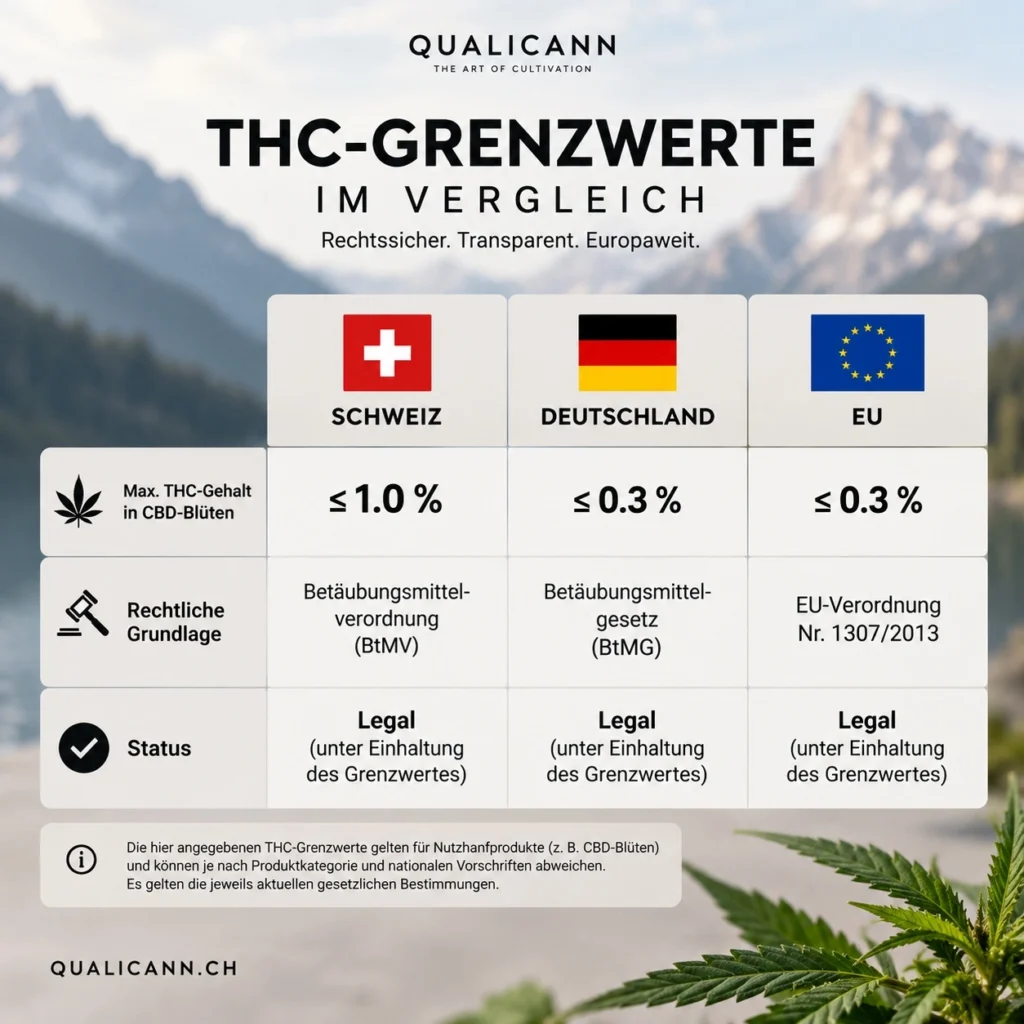
This is where things become considerably more complicated, as Swiss law no longer applies once the Swiss border has been crossed. In Germany, CBD products may be legally sold and possessed, provided they are derived from authorised EU industrial hemp and have a THC content of no more than 0.3 % – a limit that was raised across the EU from 0.2 % to 0.3 % in 2023 [6]. Swiss CBD flowers, on the other hand, fall within the legally permitted range of up to 1 % THC and therefore regularly exceed the German limit, even though they are entirely legal in Switzerland.
To add to the difficulty, the import of cannabis products into Germany is fundamentally subject to strict rules: dried flowers, which are visually indistinguishable from high-THC cannabis, can cause problems at the border regardless of the quantity carried if there is no complete documentation regarding origin, strain and THC content [5]. Legal sources also report that random tests of German CBD products have conspicuously often revealed an excessively high THC content – all the more reason why German authorities look very closely at cannabis-like material [6].
Anyone planning a trip to Germany who wants to take CBD products with them is therefore well advised to rely primarily on products with a clearly stated, low THC content and to have the laboratory certificate ready to hand. Even so, there is no guarantee that the goods will be accepted without issue at the border – when in doubt, the legally most carefree way when travelling to Germany is to stock up on goods approved locally rather than bringing Swiss CBD flowers across the border.
| Aspect | Switzerland | Germany |
|---|---|---|
| THC limit for CBD products | < 1 % | ≤ 0.3 % |
| Legal possession limit for CBD | None | No fixed quantity, but origin and variety requirements |
| Legal basis | Narcotics Act (BetmG) / Ordinance on Narcotics (BetmVV-EDI) | Narcotics Act (BtMG) in conjunction with EU industrial hemp regulation |
| Imports from the respective other country | Mostly unproblematic for travellers | This carries a risk if not documented, as Swiss goods often exceed 0.3 % |
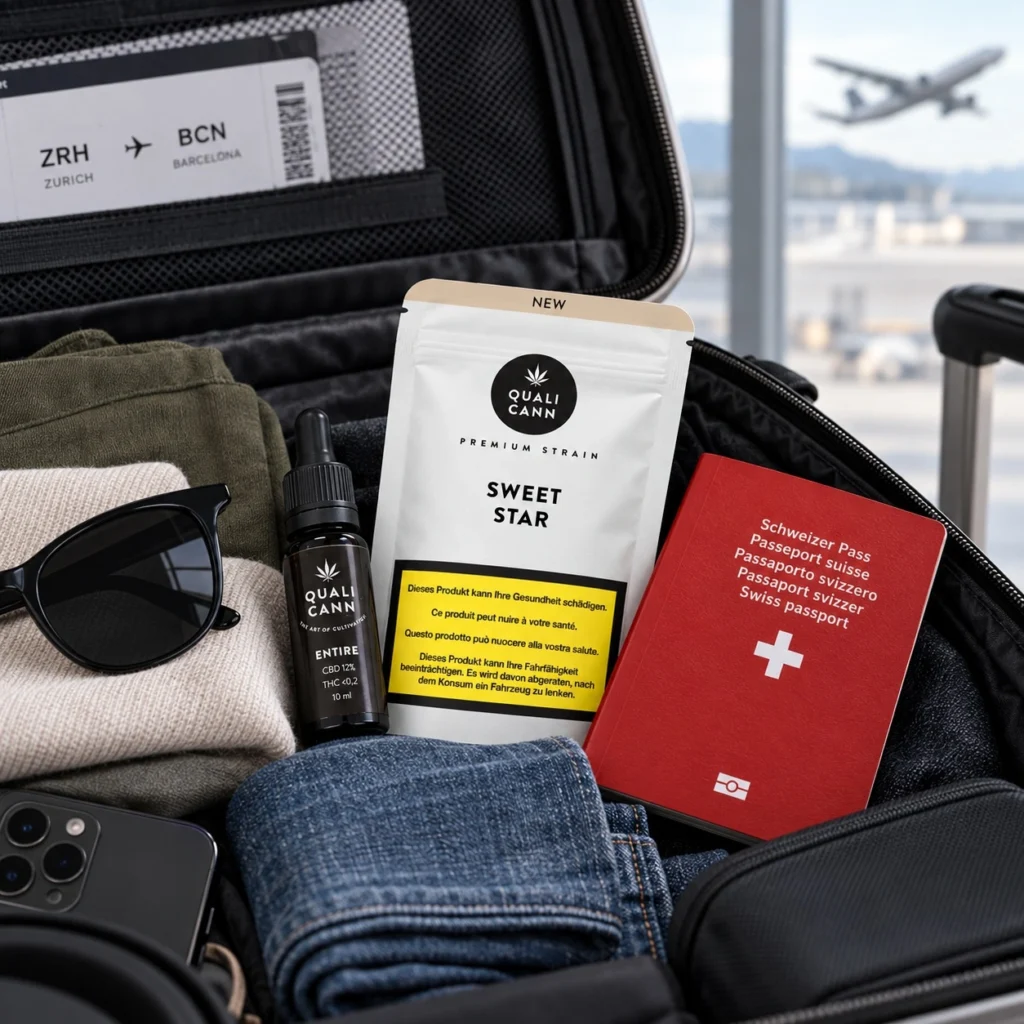
CBD at the airport: what to consider?
At the airport, a simple basic rule applies: the law of the destination country is decisive, not Swiss law. For flights within Switzerland or to countries with similarly liberal CBD regulations, this is generally unproblematic. When travelling to countries with stricter regulations – which, alongside Germany, also includes the entire Gulf region, where even the tiniest traces of THC can be prosecuted under criminal law – caution is advised.
At security control itself, the primary focus is on prohibited items rather than the material composition of plant material; however, dried flowers can draw visual attention and lead to an additional check. The same forms of proof that help during an internal inspection – original packaging, proof of purchase, laboratory certificate – are also useful at the airport, but they do not replace knowledge of the legal situation in the destination country.
Those who travel with CBD products more frequently should check the legal situation of the respective destination country before departure with an official source – such as the destination country's embassy or foreign office – as regulations can change faster than travel guides reflect. A more detailed overview of this topic, including further country examples, can be found in our article on travelling by plane with CBD oil.
Frequently Asked Questions
How much CBD am I allowed to possess in Switzerland?
There is no legal limit for CBD products containing less than 1 % THC, as they are not classified as narcotics.
Is CBD actually legal in Switzerland?
Yes, CBD products containing less than 1 % THC are legal in Switzerland. You can find a detailed overview of the current legal situation in our article on Legality of CBD in Switzerland.
Am I allowed to bring CBD flowers into Germany?
Legally speaking, no: Swiss CBD flowers, with THC levels of up to 1 %, often exceed the German limit of 0.3 % and may cause problems upon import.
What happens if the police mistake CBD flowers for cannabis?
In cantons with rapid tests, this can usually be clarified within minutes. Otherwise, laboratory analysis may be necessary, until which time the goods are generally impounded.
What is the maximum permitted THC content in legal CBD?
In Switzerland, the limit is less than 1 % THC; in Germany and the EU, it is a maximum of 0.3 % THC.
This information reflects the current legal situation to the best of our knowledge, but does not replace legal advice in individual cases. For specific legal questions, consultation with a specialist or the competent authority is recommended.
Sources
- Federal Office of Public Health FOPH: Cannabis – Low-THC cannabis and CBD
- Fedlex: Narcotics Act (BetmG), SR 812.121
- Solothurner Zeitung: Solothurn Cantonal Police introduce quick test for cannabis
- Federal Office for Customs and Border Security BAZG
- Kämpf Law Firm: Import of cannabis under the KCanG
- The law firm: CBD legal situation in Germany
For each batch of our CBD Flowers we provide an up-to-date laboratory certificate – handy to have ready to hand during an inspection or when travelling. You can find an overview of the corresponding test reports in our lab reports.