«I have an important meeting tomorrow – can I smoke CBD flowers this evening without feeling spaced out afterwards?» We receive messages like this in our customer service almost daily. Behind this lies a valid uncertainty: CBD comes from the same plant as cannabis, smells identical, looks identical – and yet it is not supposed to be intoxicating. This article explains to you why that is the case, what actually happens at the receptor level and what you realistically feel.
At a glance
- CBD (cannabidiol) does not get you high. The reason lies in the binding to the CB1 receptor in the brain – CBD has only a very low affinity there, whereas THC has a high one.
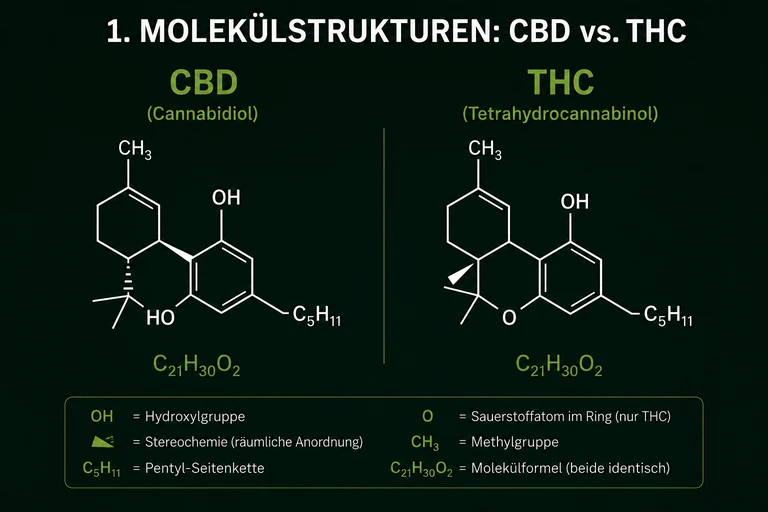
- CBD and THC have almost the same chemical formula, but a differently folded molecular structure. Exactly this determines the effect.
- The WHO classified pure cannabidiol as non-psychoactive in terms of an intoxicating effect and saw no potential for abuse.
- In Switzerland, cannabis products are subject to a total THC limit of 1 %. CBD flowers are sold as tobacco substitutes and are subject to tobacco duty.
- CBD itself does not trigger a drug test – however, legal traces of THC below 1 % may well do so in individual cases.
Does CBD get you high – yes or no?
No. CBD does not produce a high, euphoria, altered perception of time or cognitive impairment in the sense of a THC high. That is not a marketing claim, but the state of pharmacological research. The WHO Expert Committee on Drug Dependence (ECDD) concluded in its critical review of cannabidiol that pure CBD has no intoxicating properties and shows no potential for dependence or abuse [3].
Swiss law also follows this line of reasoning. On its cannabis webpage, the Federal Office of Public Health states that cannabidiol – unlike the psychoactive THC – is not subject to the Narcotics Act because it has no comparable psychoactive effect [2]. You can therefore legally buy CBD flowers in Switzerland, provided the total THC content is below 1 %. You can find out more in our article «Is CBD legal in Switzerland?)
A comparison makes this tangible: caffeine and theobromine are both alkaloids from the same class of substances, both act on the nervous system – yet nobody would claim that a piece of chocolate acts like a double espresso. With CBD and THC, the difference is even clearer. Same plant, related molecules, fundamentally different behavior in the body.
Why doesn't CBD get you high?
Because CBD does not flick the switch responsible for the high: the CB1 receptor. This receptor is located primarily in the central nervous system, and it is only when it is activated that what consumers describe as being «high» occurs. CBD barely binds to it at all.
What actually is the CB1 receptor?
Your body has its own endocannabinoid system – a network of receptors and the body's own messenger substances that is involved in the regulation of sleep, appetite, pain perception and mood, among other things. The two most important docking sites are called CB1 (predominantly in the brain and spinal cord) and CB2 (predominantly in immune cells). The high is produced almost exclusively via CB1 in the brain.
Imagine CB1 as a lock. THC is a key that fits and turns – it activates the receptor as a so-called partial agonist, meaning a substance that triggers the signal. CBD is a key that can indeed be inserted into the same lock, but practically does not turn. In his widely cited review in the British Journal of Pharmacology, the pharmacologist Roger Pertwee describes that CBD shows only a very low affinity for CB1 and CB2 receptors and does not unfold any detectable psychoactive effect there [1].
How can the effect be so different when the molecules are so similar?
CBD and THC both share the chemical formula C₂₁H₃₀O₂ – the exact same number of carbon, hydrogen and oxygen atoms. The difference lies in their spatial arrangement: THC has a closed ring section, whereas CBD has an open hydroxyl group in the same place. This single structural deviation determines whether the molecule fits into the binding pocket of the CB1 receptor.
It's like two keys cut from the same blank: same metal, same weight, but a different bit. One opens the door, the other just scratches inside the lock.
What is the concrete difference between CBD and THC?
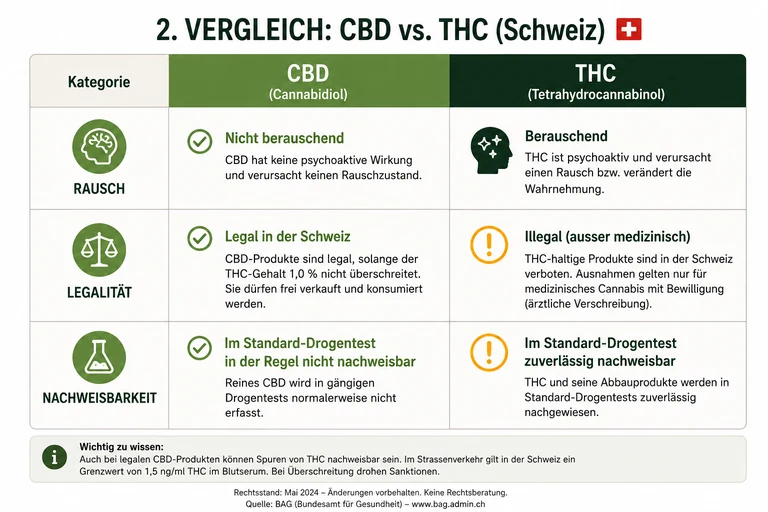
The short answer: in receptor binding, in the legal classification, and in everything that follows from it. The following overview summarises what is relevant in practice.
| Feature | CBD (Cannabidiol) | THC (Tetrahydrocannabinol) |
|---|---|---|
| Binding to CB1 receptor | Very low affinity, tending to be modulating | High affinity, partial agonist |
| Intoxicating effect | No | Yes |
| Legal classification Switzerland | Not subject to the Misuse of Drugs Act | Narcotic drugs containing 1 % or more of total THC |
| Salary in legal Swiss cannabis flowers | Mostly double-digit (depending on the variety) | Below 1 % (statutory limit) |
| detection in a drug test | Not captured by standard tests | Is there a targeted search (metabolite THC-COOH)? |
| Impairment of driving ability | Not through CBD itself | Yes |
The final point needs clarification, which is often overlooked: even though CBD does not impair you, the legal traces of THC can become an issue when driving. The Swiss limit for THC in the blood is 1.5 micrograms per litre and can be exceeded after consuming just a single CBD flower. How long you should wait to be on the safe side, we have covered in our article on CBD and driving broken down.
Is psychoactive the same as intoxicating?
No – and that is the misconception we encounter most often. Many people read somewhere that CBD is «psychoactive» and conclude from that it must somehow get you high. However, the two terms do not mean the same thing.
In technical terminology, psychoactive simply means that a substance crosses the blood-brain barrier and has a measurable effect on the nervous system. According to this definition, caffeine, valerian and a glass of red wine are also psychoactive. Intoxicating, on the other hand, is only when a substance alters perception, judgement and motor skills to such an extent that one can speak of a state of intoxication. CBD can fall into the first category, but not the second.
So whoever reads «CBD is psychoactive» is not reading a warning, but a technical description. It is precisely this distinction that the WHO also makes in its report: no intoxication, no potential for abuse, no development of dependence [3].
What do you realistically feel when you consume CBD?
Honest answer: for many people, initially not much that's spectacular. Anyone expecting a clear effect like with THC is often disappointed – and that's not a product defect, but the logical consequence of receptor biology.
What consumers feed back to us is mostly subtle: a sense of physical calm, less inner rumbling, and for some, a slight feeling of heaviness. Others report no noticeable change at all. Studies suggest that individual reactions to cannabidiol vary greatly – also depending on the strain, terpene profile, and method of consumption. It is important to make the distinction: relaxation is not a high. Your perception remains clear, your coordination unchanged, you stay in control.
A concrete comparison from our advisory service: clients coming from THC cannabis often describe the difference like this – with THC, the head gets quieter because it changes; with CBD, at most the body becomes calmer while the head stays the same. Anyone who brings this expectation with them will not be surprised.
What is the entourage effect – and does full-spectrum get you high after all?
The entourage effect describes the assumption that the constituents of the hemp plant work differently when interacting than they do in isolation. Alongside CBD, full-spectrum products also contain other cannabinoids such as CBG or CBN, as well as terpenes – the aromatic compounds that make a strain citrusy, earthy or peppery. A full-spectrum product still won't get you high.
The reason is simple maths: for THC to produce an intoxicating effect, a significant amount is required. With a legally permitted THC content of less than 1 %, this amount cannot be reached even with heavy consumption – particularly as CBD is present in far higher concentrations in the same product. The FOPH even states that CBD reduces the psychoactive effects of THC [2].
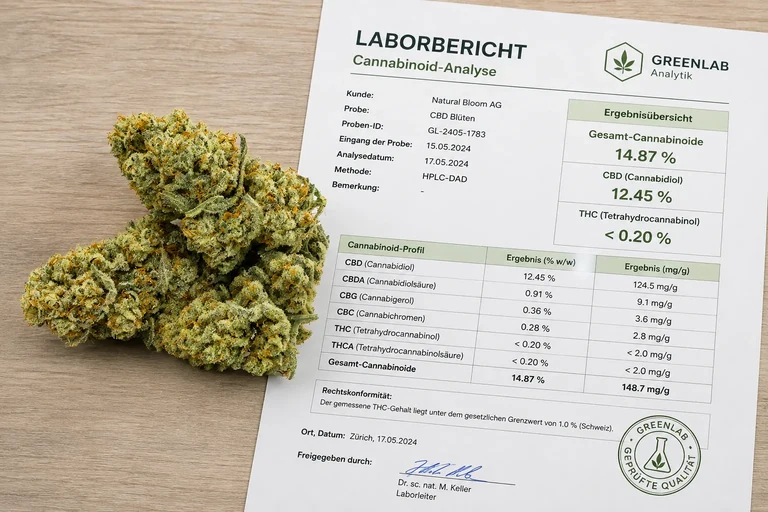
A calculation example: A flower containing 0.8 % THC contains around 8 milligrammes of THC per gramme – spread across several consumption units and with significant loss due to combustion. By way of comparison, a typical single psychoactive dose of THC is many times higher. The high therefore fails to materialise, not because it is suppressed, but simply because the active ingredient is lacking. Our CBD Flowers are analysed by accredited laboratories prior to sale, and the THC level of each batch is documented.
Does CBD hash get you high?
No – CBD hash doesn't trigger a THC high either. It's more concentrated, but the concentration primarily affects the CBD, not the THC.
CBD hash is produced by sifting or pressing the resin glands (trichomes) from CBD-rich cannabis. These glands contain the majority of the cannabinoids and terpenes; accordingly, the CBD content increases significantly compared with the original flower. Although the THC content also rises, the legal limit of 1 % total THC applies to the final product. CBD hash that is legally available for sale must comply with this limit; otherwise, it would be classified as a controlled substance.
In production we see precisely that: in hash productiong (Article on CBD Hash – History, Production, Law & Varieties) we have to select the source material carefully, because a flower containing 0.7 % THC would quickly push the concentrate above the limit. Every batch of our CBD Hash is tested by accredited laboratories and is registered with the BAG as a tobacco substitute product. So what you feel is a more intense flavour and a stronger terpene profile – no other mechanism of action.
Can you trigger a drug test with CBD?
CBD itself is not detected by standard drug tests – but yes, a positive result is still possible. The legal traces of THC are responsible for this.
Standard tests do not look for CBD, but for THC-COOH, a breakdown product of THC. A study by a research group at Johns Hopkins Medicine investigated precisely this question: after ingesting pure CBD, virtually all urine samples were negative. By contrast, after inhaling CBD-dominant cannabis containing around 0.39 % THC, several samples tested positive [4]. The authors concluded that pure CBD does not cause a positive test result, whereas CBD products containing THC do.
In practice, this means that if you are regularly tested for work – such as in transport, aviation or safety-critical roles – caution is advised. With repeated use, THC metabolites accumulate in fatty tissue, and a rapid test does not distinguish between legal CBD hemp and illegal cannabis. A laboratory report for your product can help during secondary confirmation, but it does not change the screening result itself.
Frequently Asked Questions
Does CBD make you tired?
Some people report a feeling of calm, others feel nothing at all – a sedative effect in the pharmacological sense has not been proven for CBD. The reaction is individual and also depends on the strain and terpene profile.
How much THC is in CBD flowers from Switzerland?
The legal limit is less than 1 % of total THC. Reputable suppliers state the actual value for each batch in the laboratory report. CBD flowers are classified as a tobacco substitute and are subject to tobacco duty.
Can you become addicted to CBD?
In its assessment, the WHO expert committee found no evidence of any dependence or abuse potential from pure cannabidiol.
Is CBD legal in Switzerland?
Yes, provided that the total THC content is below 1 % and the product is correctly labelled and placed on the market under the appropriate legal category – flowers as a tobacco substitute, oils, for example, as flavouring oils under chemicals legislation.
Am I allowed to drive a car after consuming CBD?
CBD itself doesn't affect your fitness to drive. However, the legal traces of THC can lead to a positive roadside test during a check. We have written down the details about this separately.
Sources
- Pertwee RG: The diverse CB1 and CB2 receptor pharmacology of three plant cannabinoids. British Journal of Pharmacology, 2008 (PMC2219532)
- Federal Office of Public Health FOPH: Cannabis – Low-THC cannabis and CBD
- WHO Expert Committee on Drug Dependence: Cannabidiol – Critical Review Report, 2018
- Spindle TR et al.: Urinary Excretion Profile of Cannabinoid Analytes Following Acute Administration of Oral and Vaporized Cannabidiol. Journal of Analytical Toxicology (PMC7152694)
If you want to try CBD without expecting a high, you can find analysed products with us CBD Flowers with documented THC content as well as CBD Oil as an aroma oil. Every batch comes with a laboratory report – take a look at it before you order. And if you are unsure which variety suits you: Our expert advisors are happy to help, completely without sales pressure.