
Updated: September 2026 · Originally published: December 2019
You smoked a CBD flower the evening before – and have to get into the car the next morning. Are you allowed to drive? The short answer: it depends less on the CBD than on what else is in the product – and that applies to flowers just as much as to other full-spectrum products. If you are looking into the subject Full-spectrum products and driving informed, you quickly end up with contradictory statements – yet the whole thing can be resolved with a single Drug test- Explain principle: Testing is not for CBD, but for THC.
Key facts at a glance:
- CBD itself is not detectable in any standard drug test – saliva, blood and urine tests measure THC, not CBD.
- Full-spectrum products like CBD flowers and CBD hash. When smoking a flower, that is enough to be detectable in the blood.
- In road traffic, there is a strict zero-tolerance policy for THC: from 1.5 ng/mL in the blood, you are considered unfit to drive, regardless of whether you feel impaired.
- On-site saliva tests are only for preliminary clarification – only the blood test at the hospital is legally binding.
- Anyone wanting to be on the safe side: use THC-free isolate or allow enough time between use and driving.
The short answer
Yes, you are generally allowed to drive a car after using pure CBD – CBD itself is not on any substance list checked during a traffic stop. Article 31, paragraph 2 of the Road Traffic Act (SVG) requires every driver to have the necessary physical and mental capacity. There is no statutory limit for CBD because the substance does not have a psychoactive effect relevant under the law.
The caveat does not concern CBD, but rather what else is contained in full-spectrum products: THC. In Switzerland, such products may contain up to 1 % THC and still be sold legally – that is the limit under narcotics law (BetmG). However, a completely different, much lower limit applies to road traffic: 1.5 ng/mL of THC in the blood. In practice, these two figures are often confused, but they are completely different standards for two different laws.
Therefore, a product that sits completely legally on the shelf can theoretically lead to a positive THC blood test after use – not because it is illegal, but simply because the road traffic limit is set tighter than the sales limit. Exactly this gap between «buying legally» and «driving legally» is the core of the issue.
The problem: trace THC, not CBD
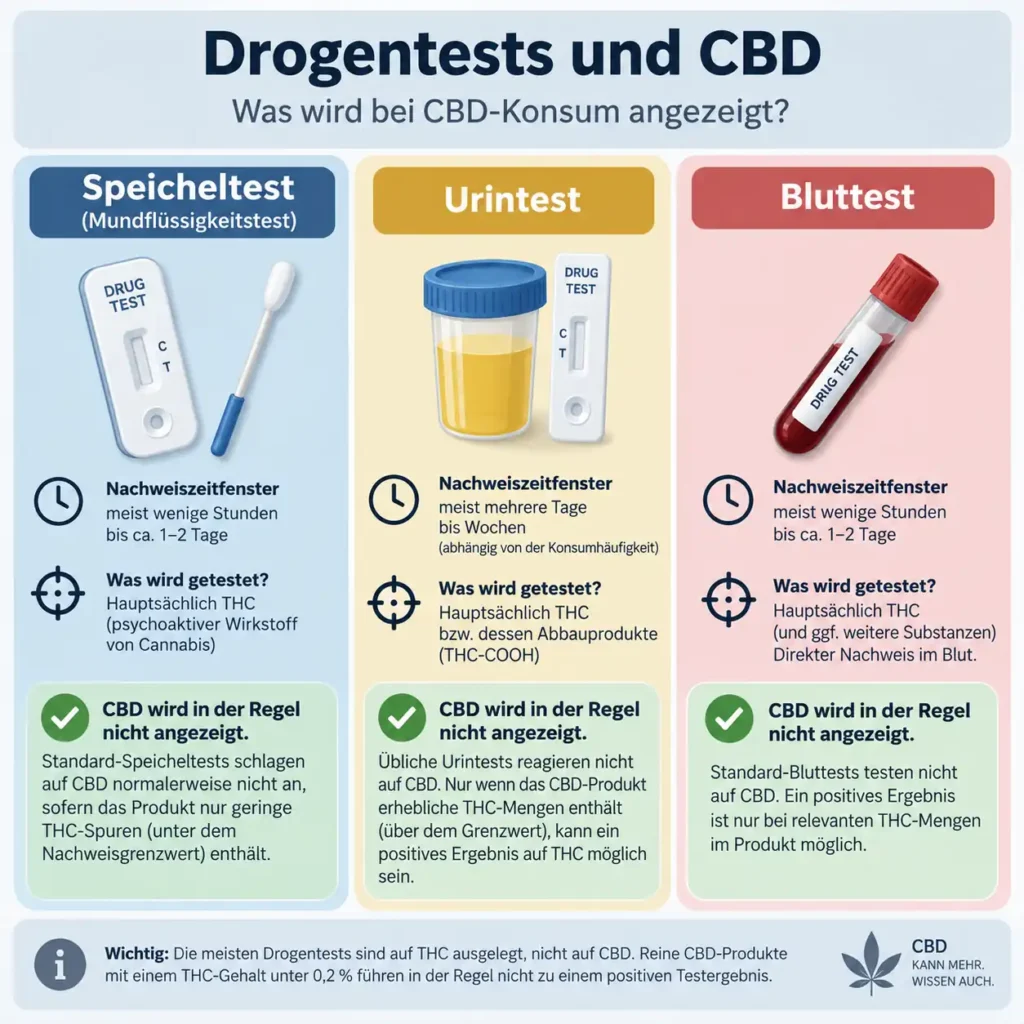
Cannabidiol (CBD) and tetrahydrocannabinol (THC) are two distinct cannabinoids with different effects on the body. Studies suggest that CBD hardly binds to CB1 receptors in the brain and therefore does not produce a high – unlike THC. Commercial drug tests, whether saliva, blood or urine tests, are accordingly designed for THC or its degradation products. CBD itself is not detected by any of the three testing methods.
It only becomes relevant with so-called full-spectrum products. In addition to CBD, these also contain the plant's other cannabinoids, including traces of THC – legally limited to under 1 % in Switzerland. This category includes CBD Flowers and CBD Hash. Those looking instead for a CBD product with no detectable THC will find this in THC-free products, such as some Cosmetics, tea or isolates.
At this point, transparency is better than beating about the bush: as with all our products, we also state the THC level transparently here. Exactly how much THC a batch actually contains can be verified via the certificate of analysis (COA) that we provide for our products. With our CBD flowers, the case is simpler: they are smoked or vaporised, meaning the THC they contain enters the body directly – which is why the connection to fitness to drive is immediately relevant here.
Which drug test detects what?
During a traffic stop in Switzerland, three main types of test are generally used, although they are used with varying frequency and have differing evidentiary value. The following overview shows what is measured in each case and where the limits lie.
| Testart | Where used | What is measured | Evidentiary value |
|---|---|---|---|
| saliva test | Right during the roadside check | Current, more recent consumption of THC | Preliminary assessment, not legally binding |
| Blood test | After a positive saliva test, in hospital | THC concentration in ng/mL of blood | legally decisive evidence |
| Urine test | Rarely during traffic checks, more likely with driving licence conditions | THC-COOH (breakdown product, even weeks later) | Shows past consumption, not current driving ability |
saliva test (rapid test)
The saliva test is the police's standard tool during a suspected-offence check. It delivers a result within a few minutes and detects recent THC consumption. Its advantage lies in its simple, straightforward application directly on site. Its disadvantage: rapid tests of this type are considered comparatively inaccurate and therefore serve exclusively for preliminary clarification – a positive result alone is not legally sufficient.
If the saliva test is positive, the next step almost always follows: a blood sample. The saliva test therefore does not determine a fine, but only whether the police have reasonable suspicion to pursue the matter further.
Blood test
The blood test is the actual piece of evidence. It is carried out in hospital after a positive saliva test and provides an exact THC concentration in nanograms per millilitre of blood. Since 2005, the legal limit has remained unchanged at 1.5 ng/mL – anyone above this level is considered unfit to drive within the meaning of Art. 91 para. 2 of the Road Traffic Act (RTA), regardless of how they subjectively feel.
This limit is purely analytical and should not be equated with an actual impairment. The Federal Council has been discussing for some years whether a higher, risk-based limit (around 3 ng/mL) would make more sense – a report commissioned by the Federal Office of Public Health (FOPH) has examined several options in this regard. Until any potential change in the law, however, the current zero-tolerance rule continues to apply.
Urine test
The urine test plays hardly any role in routine traffic stops, but is used in traffic medicine requirements, for example after a previous driving licence revocation. It does not detect THC itself, but its breakdown product THC-COOH – which can be measurable even weeks after last use without any current impairment being present.
How unreliable this snapshot can be is shown by a case documented by the observer: A driver who had completely stopped consuming cannabis and had lost a lot of weight tested positive again in routine urine tests. The reason: THC stored in fatty tissue was released again during the breakdown of body fat and released into the blood. An administrative court later recognised this explanation as plausible.
How long to wait after use?
There is no blanket, legally binding waiting period - metabolism, body weight and the amount of product used vary too much. As a rough guide: after a full-spectrum product with up to 1 % THC, a waiting period of around 24 hours is recommended before getting back behind the wheel. This rule of thumb appears in several independent guides and corresponds to the order of magnitude in which traces of THC from small amounts typically fall below the limit of 1.5 ng/mL.
For THC-containing cannabis with significantly higher concentrations – around 18 % THC, as found in unregulated products on the black market – the calculation looks different. Here, detection in the blood can take 48 to 72 hours or longer, depending on the amount consumed and frequency. This difference clearly shows how much the waiting time depends on the THC content of the respective product and why a declared, laboratory-tested THC value helps in assessing one's own situation.
In our customer interactions, we regularly encounter this question, usually in the form: «How long not to drive a car after CBD?» Our honest answer is always: There are no guarantees, only probabilities. Anyone who relies on a car for work or personal reasons and values legal certainty should therefore not rely on a rule of thumb, but plan structurally – see the practical tips in the next section.
Practical tips for when you're out and about
Anyone wishing to protect themselves can do so with a few concrete measures rather than relying on a gut feeling.
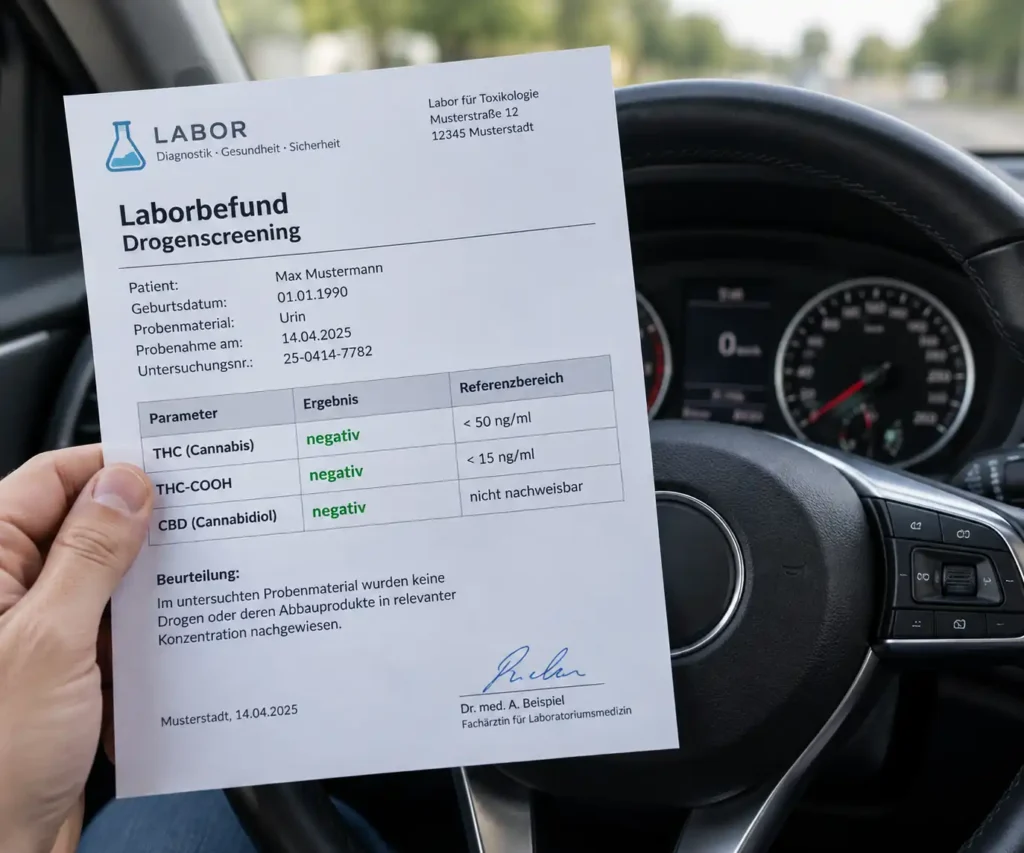
Carry a laboratory report. Every batch of our products is tested in an accredited laboratory, and the certificate of analysis (COA) shows the exact THC content. This document does not replace a blood test, but it helps when speaking with the police to make your situation understandable should you be stopped.
Switch to THC-free products. Those who drive regularly and do not want to go without CBD, but wish to avoid any traces of THC, will find THC-free products with no detectable THC in our range. This structurally reduces the risk of a positive blood test, regardless of waiting times.
Allow for extra time. Anyone who has used a full-spectrum product should expect the roughly 24 hours already mentioned before driving again – or rather more in the case of larger amounts or frequent consumption. When in doubt, the rule of thumb is: leaving an extra night between use and driving does no harm.
Assess one's own fitness to drive honestly. Regardless of the THC limit, anyone who feels tired, unable to concentrate or otherwise impaired should not get behind the wheel, regardless of cannabis consumption. The law requires physical and mental fitness to drive – not just a clean blood test.
What to do during a police stop?
A common misconception is that the police are allowed to test for THC at will during any check. That is not correct: a saliva test or even a blood sample requires a specific initial suspicion – such as conspicuous driving behaviour, visible signs like bloodshot eyes, carrying cannabis, or unusual speech. Without such indications, a regular traffic stop remains without a substance test.
If there is a suspicion, the check typically takes place in two stages: first the saliva test on site, and following a positive result, a blood sample at the hospital. The police can temporarily confiscate the driving licence even if there is reasonable suspicion; the final decision lies with the cantonal motor vehicle office, based on the laboratory result of the blood test.
Anyone who behaves normally, shows no signs of impairment and is not visibly carrying cannabis generally has little to fear during a routine check. If a blood sample is taken nonetheless, carrying a laboratory report can help classify the origin and declared THC content of a product used – but, as mentioned, does not replace one's own assessment of fitness to drive.
Frequently Asked Questions
Can a full-spectrum product cause a positive drug test?
CBD itself does not. However, if the product contains traces of THC, as is common with full-spectrum products up to 1 %, this can show up in a blood test, for example when smoking flowers.
How long is THC detectable in the blood after a full-spectrum product?
For full-spectrum products with up to 1 % THC, this is usually around 24 hours, depending on the amount, metabolism and body weight. There is no guarantee.
Can the police just test me for THC?
No. A saliva test or a blood sample requires concrete suspicion, not a random spot check.
Is a CBD isolate safer for driving?
Yes. THC-free products contain no detectable THC and structurally reduce the risk of a positive blood test, regardless of waiting times.
What happens if the saliva test is positive, but the blood test is negative?
Legally, the blood test counts. A positive saliva test is only a preliminary check; if the subsequent blood test falls below the limit of 1.5 ng/mL, no offence has been committed.
Anyone wanting to play it safe when it comes to fitness to drive should steer clear of full-spectrum products.
Note: This article provides general information on the current legal situation and does not replace legal advice in individual cases.
Bibliography
- Federal Office of Public Health (FOPH): Fact sheet on THC limits in road traffic
- Federal Office of Public Health (FOPH): Report on THC limits in road traffic
- Road Traffic Act (RTA, SR 741.01), esp. Art. 31 and Art. 91: Fedlex
- TCS Switzerland Drug driving
- Toxcontrol Diagnostics Drug test for the police
- sicher-testen.ch: Driving penalties
- Observer: Stopped smoking weed – still tested positive
Additional information for interested parties:
HOW DOES THE BREAKDOWN AND METABOLISATION OF THC WORK
In order to understand how long you should not drive after consuming cannabis containing THC, it is important to consider how THC works in the body and to understand the breakdown process. The following calculation should clarify why longer waiting times are necessary after smoking THC weed before you can drive safely again.
1. CONSUMPTION OF THC
An average joint contains about 0.3 to 0.5 grams of cannabis. With a THC concentration of 18% this means that a joint is approximately 54 to 90 milligrams of THC contains.
2. THC UPTAKE IN THE BODY
The bioavailability of THC through smoking is about 30%. This means that only around a third of the THC consumed actually enters the bloodstream. With a joint containing 0.5 grams of cannabis (90 mg THC), around 27 mg THC are actually absorbed into the bloodstream.
3. METABOLISATION OF THC IN THE BODY
After absorption into the bloodstream, THC is broken down relatively quickly in the liver into various metabolites. The main metabolite is THC-COOH, which is excreted in the urine. However, THC itself has a half-life of about 1 to 4 hours in the blood, whereby the concentration drops relatively quickly.

4. REDUCTION OF THC BELOW THE LIMIT VALUE OF 1.5 MICROGRAMS PER LITRE OF BLOOD
The legal limit in Switzerland is 1.5 micrograms of THC per litre of blood. After consuming a joint with 90 mg of THC and ingesting about 27 mg of THC, the THC level in the blood would initially rise to about 100 to 200 micrograms per litre of blood (depending on various factors such as metabolism and body weight).
To fall below the limit of 1.5 micrograms per litre, THC must be broken down over several hours or days. With a half-life of 1 to 4 hours, the THC level in the blood can be roughly estimated. After about 8 to 12 hours the THC content has dropped significantly, but is probably still above the limit. Only after 24 to 72 hours, depending on the individual metabolism and the amount consumed, the THC value falls below the limit of 1.5 µg/L in most cases.
5. THC INFLUENCE ON THE ABILITY TO DRIVE
While the THC content in the blood plays a decisive role in legal terms, it should be emphasised that the pure blood value does not always correlate reliably with actual fitness to drive. In fact, many users are completely lucid and fit to drive again after just a few hours after consuming THC, even though the THC level in their blood is still above the legal limit.
The psychoactive effect of THC is often only noticeable in the first few hours after consumption. After that, most users feel normal again and are fully able to carry out their usual activities - including driving. However, despite the decrease in effect, THC residues may be detectable in the blood or urine for longer. In practice, this means that you may feel able to drive again for a long time while the THC blood level is still above the permitted limit. There are enough bizarre cases in Switzerland to illustrate this: No longer smoking pot - but still tested positive | Observer
It is therefore important to understand that although the legal limit is intended to minimise the risk, it does not always reflect the individual reality of consumers. Nevertheless, if you want to be on the safe side, it is necessary for legal reasons to observe this limit in order to avoid fines or the loss of your driving licence.
(Important: However, it should also be pointed out here that the police cannot or may not carry out arbitrary checks for THC in the blood. Without concrete suspicion, the police have no reason to check you for THC in your blood on the following day of potential consumption and, provided you feel fully fit to drive (and are not carrying cannabis or other suspicious paraphernalia), you are unlikely to be stopped.)
(These waiting times are a conservative estimate based on average metabolic rates and consumption of THC. However, individual differences (metabolism, body fat percentage, frequency of use) may increase the time to cut down).
CBD products in the shop with THC
-
 1 PREROLLED JOINT BANANA DIESELCHF7.90
 -
 SWEET STARCHF21.00 – CHF54.00Preisspanne: CHF21.00 bis CHF54.00
 -
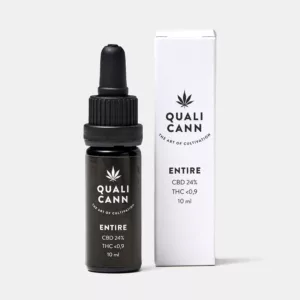 CBD ÖL ENTIRE (24% CBD)CHF119.00
CBD products in the shop without THC
-
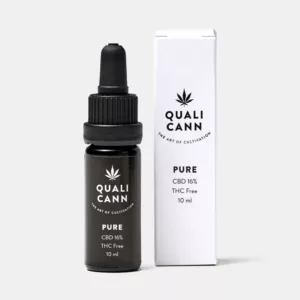 CBD OIL PURE (16% CBD)CHF89.00
 -
 CLOUD NINECHF19.90
 -
 CANNA LOTIONCHF39.90
