
INTRODUCTION
Can you drive after consuming CBD or THC? The answer is not that simple, because while CBD itself is not prohibited, there are clear legal limits for THC in road traffic. Those who do not comply with the rules risk fines or even losing their driver's license.
Cannabis and driving in Switzerland: key points at a glance:
✅ CBD ist grundsätzlich erlaubt, aber beeinträchtigte Fahrtüchtigkeit kann trotzdem problematisch sein.
✅ THC ist im Straßenverkehr verboten – es gilt eine strikte Nulltoleranz.
✅ CBD Cannabis mit bis zu 1% THC kann Spuren im Blut hinterlassen, weshalb eine Wartezeit von 24 Stunden empfohlen wird.
✅ THC Blüten mit höheren THC-Werten bleibt bis zu 72 Stunden nachweisbar.
✅ Die Polizei darf nicht willkürlich auf THC testen, sondern benötigt einen konkreten Verdacht.
WHAT YOU WILL LEARN IN THIS ARTICLE:
📌 CBD & driving - When is it permitted? What are the risks?
📌 Wie lange sollte man nach dem Konsum von CBD Produkten mit THC warten?
📌 THC & Driving - How long does THC remain detectable?
📌 Wie funktioniert der THC Abbau im Körper?
📌 What are the penalties for an inspection?
Aber eins nach dem anderen. In den folgenden Abschnitten erfahren Sie ausführlich worauf Sie bei CBD und THC im Strassenverkehr achten müssen.
DRIVING AND CBD

As mentioned at the beginning, there is no official limit for CBD (cannabidiol) in road traffic. The consumption of CBD is therefore not prohibited in road traffic. This means that the consumption of pure CBD products is not legally problematic. However, this does not mean that you are always allowed to drive a vehicle after taking pure CBD. As is the case with medication (for which driving is not expressly prohibited) or fatigue, everyone has to judge for themselves whether they are still fit to drive.
The Road Traffic Act (SVG) clearly states: ‘Every driver must have the necessary physical and mental capacity, otherwise they are unfit to drive.’ According to TCS Switzerland, this means: ‘If there is the slightest doubt, keep your hands off the wheel» – www.tcs.ch/de/testberichte-ratgeber/ratgeber/unfallursachen/medikamente.php
HOW LONG NOT TO DRIVE AFTER CONSUMING CBD PRODUCTS (<1% THC)
Although the consumption of pure CBD is unproblematic, many legal CBD cannabis products in Switzerland contain up to 1% THC. After consuming such CBD products, small amounts of THC can be detected in the blood, which could affect driving ability.
It is recommended that after consuming CBD products with up to 1% THC at least 24 hours before driving a vehicle again. This ensures that the THC content in the blood falls below the legal limit. Although the quantities of THC are small and an impairment of effective driving ability is unlikely, absolute zero tolerance applies by law in road traffic, which is why any detectable amount of THC could become a problem, as will become clear in the text below. Conclusion:
How long not to drive after CBD? If you want to be on the safe side, in the case of CBD products with up to 1% THC, wait 24 hours to be on the safe side.
📢 But important: The police are not allowed to arbitrarily check for THC in your blood. What's more, officers would have to take you to hospital to take a blood sample for a THC test. To do this, they need a concrete suspicion. This could be red eyes, unclear pronunciation, cannabis carried in the car or other factors that indicate the consumption of cannabis. However, if you behave normally and do not feel impaired and fully fit to drive, you have little to fear even if you are tested after consuming CBD cannabis.
CONCLUSION CBD WEED AND DRIVING:
The consumption of pure CBD (cannabidiol) is generally not prohibited in road traffic. However, anyone who feels tired or otherwise impaired in any way after consuming CBD should never get behind the wheel!
DRIVING AND THC

The situation is different with THC than with CBD. Here, it does not matter by law whether you still feel fit to drive. THC is strictly forbidden in road traffic. There is absolute zero tolerance by law. The detection limit for THC is 1.5 micrograms per litre of blood. This limit value is very low. A relaxation of this limit is currently being discussed. The FOPH (Federal Office of Public Health), among others, is also calling for this limit to be relaxed: https://www.srf.ch/news/schweiz/grenzwert-statt-nulltoleranz-mehr-nachsicht-mit-cbd-konsumenten-im-strassenverkehr
Currently, however, the low limit for the use of THC-containing products basically means Do not drive after taking the medicine. If the detection limit for THC in the blood is exceeded during a test, this can have serious consequences and lead to fines and disqualification from driving.
HOW LONG NOT TO DRIVE AFTER THC WEED (APPROX. 18% THC)
Im Gegensatz zu legalen CBD Produkten enthält THC-haltiges Gras deutlich höhere Mengen an THC, was die Fahreignung beeinträchtigen kann. THC Gras mit etwa 18% THC can be consumed up to 72 hours or longer in the blood, especially in the case of heavy or regular consumption.
Nach dem Konsum von THC Gras mit 18% THC wird empfohlen, mindestens 48 to 72 hours wait until the THC has largely broken down.
So, how long can you not drive after THC? With strong THC weed, the waiting time is definitely longer, and regular users should allow even more time before driving again.
CONCLUSION THC WEED AND DRIVING A CAR:
The consumption of THC (tetrahydrocannabinol) is prohibited in road traffic. Anyone who consumes products containing THC should therefore not get behind the wheel afterwards!
Additional information for interested parties:
HOW DOES THE BREAKDOWN AND METABOLISATION OF THC WORK
In order to understand how long you should not drive after consuming cannabis containing THC, it is important to consider how THC works in the body and to understand the breakdown process. The following calculation should clarify why longer waiting times are necessary after smoking THC weed before you can drive safely again.
1. CONSUMPTION OF THC
An average joint contains about 0.3 to 0.5 grams of cannabis. With a THC concentration of 18% this means that a joint is approximately 54 to 90 milligrams of THC contains.
2. THC UPTAKE IN THE BODY
The bioavailability of THC through smoking is about 30%. This means that only around a third of the THC consumed actually enters the bloodstream. With a joint containing 0.5 grams of cannabis (90 mg THC), around 27 mg THC are actually absorbed into the bloodstream.
3. METABOLISATION OF THC IN THE BODY
After absorption into the bloodstream, THC is broken down relatively quickly in the liver into various metabolites. The main metabolite is THC-COOH, which is excreted in the urine. However, THC itself has a half-life of about 1 to 4 hours in the blood, whereby the concentration drops relatively quickly.

4. REDUCTION OF THC BELOW THE LIMIT VALUE OF 1.5 MICROGRAMS PER LITRE OF BLOOD
The legal limit in Switzerland is 1.5 micrograms of THC per litre of blood. After consuming a joint with 90 mg of THC and ingesting about 27 mg of THC, the THC level in the blood would initially rise to about 100 to 200 micrograms per litre of blood (depending on various factors such as metabolism and body weight).
To fall below the limit of 1.5 micrograms per litre, THC must be broken down over several hours or days. With a half-life of 1 to 4 hours, the THC level in the blood can be roughly estimated. After about 8 to 12 hours the THC content has dropped significantly, but is probably still above the limit. Only after 24 to 72 hours, depending on the individual metabolism and the amount consumed, the THC value falls below the limit of 1.5 µg/L in most cases.
5. THC INFLUENCE ON THE ABILITY TO DRIVE
While the THC content in the blood plays a decisive role in legal terms, it should be emphasised that the pure blood value does not always correlate reliably with actual fitness to drive. In fact, many users are completely lucid and fit to drive again after just a few hours after consuming THC, even though the THC level in their blood is still above the legal limit.
The psychoactive effect of THC is often only noticeable in the first few hours after consumption. After that, most users feel normal again and are fully able to carry out their usual activities - including driving. However, despite the decrease in effect, THC residues may be detectable in the blood or urine for longer. In practice, this means that you may feel able to drive again for a long time while the THC blood level is still above the permitted limit. There are enough bizarre cases in Switzerland to illustrate this: No longer smoking pot - but still tested positive | Observer
It is therefore important to understand that although the legal limit is intended to minimise the risk, it does not always reflect the individual reality of consumers. Nevertheless, if you want to be on the safe side, it is necessary for legal reasons to observe this limit in order to avoid fines or the loss of your driving licence.
(Important: However, it should also be pointed out here that the police cannot or may not carry out arbitrary checks for THC in the blood. Without concrete suspicion, the police have no reason to check you for THC in your blood on the following day of potential consumption and, provided you feel fully fit to drive (and are not carrying cannabis or other suspicious paraphernalia), you are unlikely to be stopped.)
(These waiting times are a conservative estimate based on average metabolic rates and consumption of THC. However, individual differences (metabolism, body fat percentage, frequency of use) may increase the time to cut down).
CBD products in the shop with THC
-
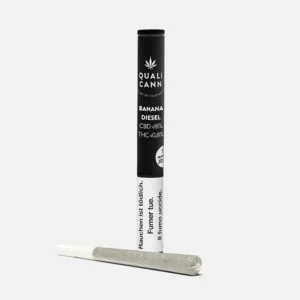 1 PREROLLED JOINT BANANA DIESELCHF7.90
 -
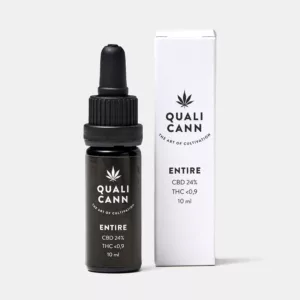 CBD ÖL ENTIRE (24% CBD)CHF119.00
 -
 SWEET STARCHF21.00 – CHF54.00Preisspanne: CHF21.00 bis CHF54.00
CBD products in the shop without THC
-
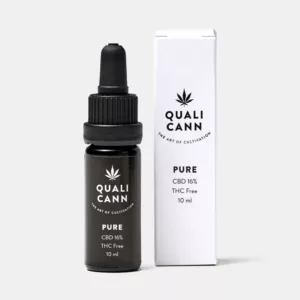 CBD OIL PURE (16% CBD)CHF89.00
 -
 CLOUD NINECHF19.90
 -
 CANNA LOTIONCHF39.90
